

TL;DR: How to Get Hired
- Focus on Business Impact: Target Elixir programming jobs in high-concurrency sectors like fintech, IoT, and real-time communication where Elixir's fault tolerance directly prevents revenue loss.
- Master the Core Stack: Deep proficiency in Phoenix, OTP (especially GenServer and Supervisor), Ecto, and LiveView is non-negotiable. Interviewers will test your architectural knowledge, not just syntax.
- Build a Proof-of-Work Portfolio: Create projects that solve real business problems, like a real-time collaborative tool or a fault-tolerant job processor. Document the "why" in your README.
- Network in Niche Communities: The best Elixir jobs are on the Elixir Forum, Elixir Slack, and Elixir Radar—not generic job boards.
- Recommended Action: Start by building a small Phoenix LiveView project that uses a GenServer to manage state. This will immediately test your grasp of the two most critical parts of the Elixir ecosystem.
Who This Guide Is For
This guide is for experienced software engineers who are looking to transition into a high-paying Elixir role or current Elixir developers aiming for a senior-level position. You'll get the most value if you are:
- A mid-to-senior backend developer (e.g., Ruby, Python, Go) who understands web fundamentals but wants to specialize in a high-demand niche.
- An Elixir developer looking to move from a junior to a senior role by demonstrating a deeper understanding of OTP and system architecture.
- A hiring manager or CTO who needs to understand what separates a great Elixir candidate from a good one.
The 4-Step Framework for Landing an Elixir Job
To secure a top-tier Elixir programming job, you need to prove you can build resilient, scalable systems that solve specific business problems. Follow this framework to structure your preparation and demonstrate your value.
- Identify High-Value Niches: Pinpoint industries where Elixir's core strengths (concurrency, fault tolerance) are business-critical.
- Master the Production Stack: Go beyond syntax. Gain deep, practical knowledge of Phoenix, OTP, Ecto, and LiveView.
- Build a Problem-Centric Portfolio: Create 1-2 projects that solve a clear business problem and showcase your architectural skills.
- Ace the OTP-Focused Interview: Prepare for system design questions that test your understanding of supervision trees and state management.
alt text: An infographic showing the key statistics for Elixir programming jobs, including average salary, demand growth, and top industries hiring.
Practical Examples: What Hiring Managers Look For
Theory isn't enough. Here are two practical examples that demonstrate the skills employers are actually hiring for.
Example 1: The Fault-Tolerant Job Processor (OTP Interview Question)
This is a classic system design question that tests your understanding of OTP, the heart of Elixir's resilience.
The Prompt: "Design a background job processor for an e-commerce site that resizes thousands of user-uploaded images. The system must be resilient to failed jobs (e.g., corrupt images) and temporary API outages (e.g., S3 is down)."
A Winning Architecture:
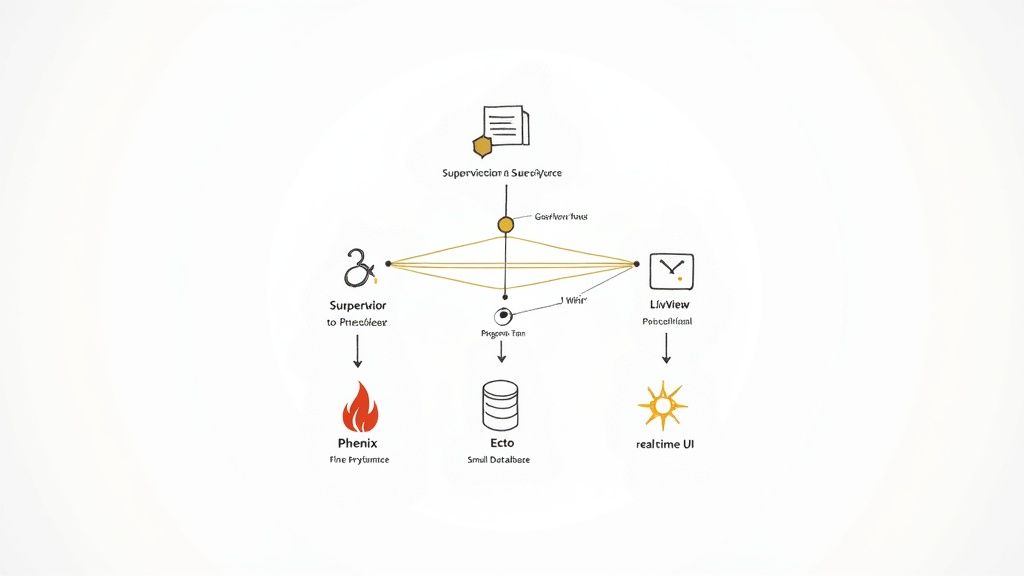
- Supervisor: Start with a top-level
Supervisorusing a:one_for_onerestart strategy. This ensures that if one job worker crashes, it won't affect the others. - DynamicSupervisor (Optional but advanced): For managing the worker processes themselves.
- GenServer (Queue Manager): A single
GenServeracts as the queue, holding a list of pending jobs in its state. - Task or GenServer (Workers): A pool of worker processes pulls jobs from the Queue Manager.
- Circuit Breaker: Implement a mechanism (like the
fuselibrary) that stops workers from hammering a failing external service (like S3), preventing cascading failures.
- Supervisor: Start with a top-level
Business Impact: This design directly addresses business risk. It guarantees that a single bad upload won't halt all image processing, ensuring a consistent user experience and protecting system uptime.
- The Business Problem: A logistics company needs a live dashboard for its operations team to track a fleet of delivery trucks in real-time on a map.
- Phoenix LiveView: Create a single LiveView process (
DashboardLive) to render the map. - Phoenix PubSub: As GPS data for each truck comes into the system (e.g., via an API endpoint), publish an event like
Phoenix.PubSub.broadcast(MyApp.PubSub, "trucks:update", %{truck_id: 123, lat: ..., lon: ...}). - handle_info/2: The
DashboardLiveprocess subscribes to the"trucks:update"topic. It uses ahandle_info/2callback to receive these broadcasts and update its assigns, which automatically pushes the new coordinates to the user's browser. - Business Impact: This provides real-time operational intelligence without the complexity of a separate frontend JavaScript framework. It reduces development time (time-to-value) and simplifies maintenance.
- Pro: You'll have a huge impact on core features and thrive in a fast-paced environment.
- Con: Your role will be less defined, and you'll wear many hats. The business risk is higher.
- Pro: You'll work on systems at a massive scale and have greater job stability and more structured career growth.
- Con: The pace is slower, and your role will be more specialized, focusing on one piece of a giant puzzle.
- Phoenix Framework: Deep knowledge of routing, controllers, contexts, and channels is non-negotiable. See the Phoenix framework docs.
- OTP (Open Telecom Platform): You must be able to architect systems using
GenServer,Supervisor, andApplication. This is the core of Elixir's fault tolerance. - Ecto: Proficiency with schemas, changesets, and composable queries for database interaction is essential.
- Phoenix LiveView: Experience building interactive, real-time UIs without heavy JavaScript is a major advantage for modern roles.
- Testing: A strong discipline in writing unit, integration, and end-to-end tests using ExUnit.
- Review OTP Concepts: Can you explain the difference between a
GenServer,Agent, andTaskand the trade-offs for each? - Whiteboard a Supervision Tree: Be ready to design a supervision strategy for a common scenario, like a worker pool. Explain your choice of restart strategy (
:one_for_one,:one_for_all, etc.). - Prepare a Project Deep Dive: Choose one of your portfolio projects and be ready to explain your architectural decisions, the problems you faced, and the trade-offs you made.
- Practice Live Coding: Work through a small, practical problem, like implementing a rate limiter with a
GenServeror building a simple Ecto query. - Prepare Your Questions: Have thoughtful questions ready for the employer about their Elixir stack, team structure, and approach to technical debt. (See "What to Do Next").
- Find Relevant Openings: Focus your search on niche boards where serious companies post. The Elixir Forum Jobs Section and Elixir Radar Jobs are the best places to start. Avoid generic job sites.
- "Why did your team choose Elixir, and how is it used in your core product?"
- "Can you describe your testing and CI/CD culture?"
- "What does mentorship and professional development look like for Elixir engineers on your team?"
- Refine Your Portfolio & LinkedIn: Update your GitHub READMEs to focus on business problems and results. Ensure your LinkedIn profile reflects this specialization. Here's how to optimize your LinkedIn profile for success.
Example 2: The Real-Time Dashboard (LiveView Project)
This project demonstrates your ability to use the modern Elixir web stack to deliver immediate user value.
Deep Dive: Trade-offs in Elixir Job Environments
The type of company you join will drastically shape your day-to-day work. Understanding the trade-offs between a startup and an enterprise is critical for finding the right fit.
alt text: A developer working on Elixir code on a large monitor in a modern office setting, focused on a complex problem.
Startups and Scale-ups
Startups often choose Elixir for new projects, especially in fintech, edtech, and real-time communication. They need to build a scalable product quickly.
Enterprise Companies
In a large corporation, Elixir is often used for specific, high-leverage systems like a central messaging backbone or a data ingestion pipeline.
Here is a quick comparison table:
Ultimately, choosing between a startup and an enterprise depends on your risk tolerance and career goals. For a wider view, see our guide on whether software engineers are in demand.
The Elixir Developer Skill & Interview Checklist
To land a high-paying Elixir job, you need to prove mastery of the ecosystem's core tools. Companies need engineers who can build resilient, scalable, real-time systems.
Must-Have Technical Skills
Your portfolio is where you prove these skills. Don't just list projects; explain the business problem each one solves.
alt text: A developer's desk with a laptop open to a GitHub profile, showcasing Elixir projects with clear, business-focused README files.
Elixir Interview Preparation Checklist
Use this checklist to prepare for your technical interviews.
Mastering these skills and preparing for the interview process demonstrates that you can do more than just write code. It shows you can architect and maintain the kind of highly available systems businesses are willing to pay a premium for. For a refresher on general engineering skills, review the core skills required for a software engineer.

alt text: A candidate and an interviewer collaborating on a system design problem on a whiteboard, focusing on OTP supervision trees.
What to Do Next
Ready to add a top-tier Elixir engineer to your team? ThirstySprout helps you hire pre-vetted, senior Elixir talent who can start delivering value in days, not months.
Start a Pilot
References
Hire from the Top 1% Talent Network
Ready to accelerate your hiring or scale your company with our top-tier technical talent? Let's chat.